The Handshake Before the Game: What a Shared Gesture Can Do
A pregame handshake can mark the shift from everyday contact to shared play; learn how timing, context, and consent shape what the gesture means.
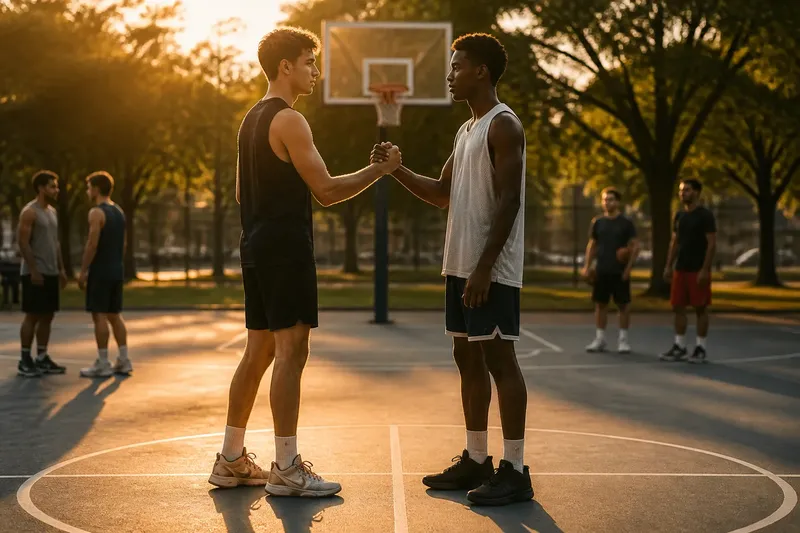
At the edge of a gym court, two players finish tying their shoes, look up, and meet palms before taking their places. That pregame handshake is brief, but it can mark a shift: the conversation is no longer only between neighbors or classmates; they are entering a sporting occasion together. The same gesture can carry different meanings for each person, and that difference is part of its significance.
A threshold in motion
A ritual is a repeated action that gathers meaning through its setting and timing. A handshake before play does not need formal rules or a speech to work as a threshold. Its position between warm-up and the opening whistle gives an ordinary greeting a particular job: acknowledging that play is about to begin.
The transition is social, not magical. Players may still be thinking about school, work, or the bus ride to the venue. But the gesture offers a small, recognizable cue to attend to the people and activity immediately in front of them.
It can also make the occasion legible to someone watching. A pair of opponents greeting one another before play shows that competition has a boundary: the players are about to contest an outcome, but they recognize one another as participants in the same event.
Timing gives it meaning
A greeting can land differently depending on when it happens. Before a game, it may signal readiness or respect; after play, a handshake can acknowledge what has just taken place. At a practice, the same contact may simply be a friendly hello.
Small details shape the moment. Players might meet near the center line, exchange a nod along with the handshake, or greet each member of the opposing side in turn. In a doubles match, partners may touch hands before serving, while opponents greet one another at the net. The location and sequence connect the gesture to that sport’s habits.
There is no need to make the greeting elaborate. If players pause to coordinate a complicated routine, the action may distract from the transition it is meant to mark. What matters is that the gesture fits the setting and the people taking part.
One gesture, several readings
One player may experience a handshake as a promise to compete fairly. Another may see it as simple courtesy, a sign of confidence, or a familiar routine that settles nerves. Someone else may take part because teammates expect it, without attaching much meaning at all.
Those interpretations can coexist. A shared ritual does not require identical private feelings; it gives participants a common action they can recognize. That is different from assuming the action proves what anyone thinks or feels.
Say a new player joins a neighborhood basketball game where the regulars tap hands before checking the ball. The newcomer follows their lead, and the tap helps show where the game begins, even if the regulars see it as friendly tradition and the newcomer sees it as a useful cue. The observable result is a coordinated start, not proof that everyone has formed the same bond.
Welcome without pressure
Because a handshake involves contact, its usefulness depends on willingness. A person may avoid it because of personal boundaries, disability, religious practice, illness, or simple preference. The sporting occasion can still be marked with a nod, a wave, a verbal greeting, or another mutually comfortable signal.
When organizing a team or casual match, offer the greeting as an invitation rather than a test of belonging. If someone declines, a calm acknowledgment keeps the focus on welcoming them into play. Pressing for an explanation can turn a small ritual into an unwanted public negotiation.
It is not worth choreographing a greeting so tightly that everyone must perform it in exactly the same way. A ritual is useful when it helps people enter the occasion, not when it becomes another rule to get right.
What does the handshake signal?
Does a pregame handshake mean opponents are friends?
Not necessarily. It can show recognition and readiness to share the contest without suggesting friendship or agreement beyond that moment.
Why greet an opponent before play?
The greeting can acknowledge the other person as a participant and mark the approaching start. Its meaning may be formal, friendly, habitual, or minimal, depending on the players and setting.
What if a player does not want contact?
A nod, wave, or spoken greeting can serve as an alternative if it suits both participants. The point is to acknowledge one another, not to require touch.
Does the gesture matter if it is routine?
Routine can be part of its function: a familiar action may help players recognize the transition into play. But nobody has to attach a deep personal meaning to it for the action to have a shared place in the event.
Notice the boundary
To understand a team’s pregame handshake, watch for its place in the sequence rather than trying to decode every player’s feelings. Does it happen before warm-ups, just before the opening whistle, or only between opponents? Does it include a nod or a few words, and can participants choose another form of greeting?
These observations reveal how a group uses the ritual without treating one version as universal. Rules for official competition, venue customs, and individual needs can shape what is appropriate; follow the applicable guidance and participants’ expressed preferences.
The handshake before a game is a small way to draw a line between ordinary interaction and shared play. Its value lies less in a fixed message than in the opening it offers: a moment for people to recognize the occasion, meet one another, and begin on terms they can accept.